A major concern of many, if not all beekeepers is the wintering over of their bees. The winter can take a huge toll on the hive and sometimes result in the death of your hive.
Saskatraz bees are a great variety to work with. I have kept them for one year now. They wintered very well and seem to be doing great for this next season. There are a few people who have reported that their Sascatraz bees were prone to swarming in the spring however.
A little bit about the Saskatraz honey bees.
The Saskatraz honey bee is a relatively newer variety or race that has become commercially available to the hobby/backyard beekeeper. They were developed in a vigorous and meticulous program. The bees were chosen from several distinct areas around the world where certain bee colonies exhibited desirable traits to be bred into a new honey bee race.
The regions included Russia, Germany, and parts of Canada. All the varieties were well adapted to colder winter conditions. The wintering-over traits found in these different colonies were bred into the Saskatraz honey bee. This has made the Saskatraz a relatively hearty bee for areas with colder longer winters.
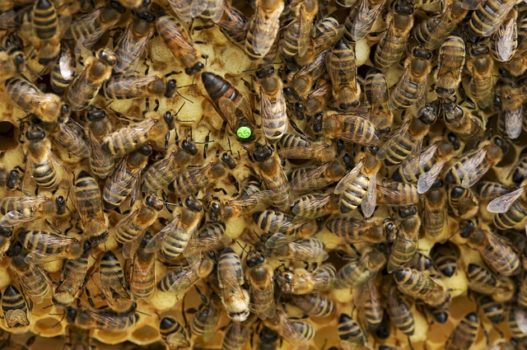
Queen honey bee marked.
Many other positive traits were bred into the Saskatraz honey bee. In fact, these other traits were the main focus of the Sakatraz project. I have an article here discussing the Saskatraz bee. It was a fascinating study and project to come up with the Saskaraz bee.
Why are wintering honey bees even something to worry about?
You may have thought that honey bees just hibernate through the winter and then wake up in the spring with no ill effects. This isn’t the case however. Honey bees stay alive and active through the winter. They don’t venture out of the hives unless it’s about 42.7 degrees F. Even then, it’s only for a cleansing flight to clear out their digestive tract.
When the temperature gets below 55 degrees F the hive will cluster up to conserve and create heat. The bees will shiver their muscles and keep the center of the cluster warm. The cluster surrounds the queen to keep her safe and warm. If the temperature of the cluster gets below 41 degrees F then bees will die. If there are not enough bees to keep the queen warn she will die as well. With no queen the colony will not function properly, and you can lose the whole hive.
Problems that arise with wintering honey bees.
There are some serious issues that can show up during winter beyond the cold that can kill honey bees. One of which is the genetic predisposition to a warmer climate. Some races of honey bees have been raised in less severe winter climates and have adapted to that. Taking these varieties into areas of a more severe winter can result in extra stress on a bee colony and result in death. This is one reason that not many Africanized honey bees are found in colder climates. The Africanized queens don’t survive the cold very well at all.
Most honey bees are prone to problems from parasites. Two of the major pericytes that beekeepers deal with are the varroa mite and the tracheal mite. These are two lousy pericytes that can destroy colonies that have been healthy and produced well for years.
During the winter months as the bees’ cluster up, the mites will go from host bee to host bee, making bees sick and killing them. The honey bees are already under stressful conditions, and the added stress of the mites can kill the bees quickly.
Another wintering problem can be improper beekeeping practices. When you are harvesting honey, it’s tempting to take as much as you dare, and maybe even a little more. I have heard the phrase of a beekeeper being too greedy. When you are too greedy and take too much of the colonies store of honey, they don’t have enough to stay alive and keep the queen safe and warm. A beekeeper, in effect can starve a hive to death.
Another poor beekeeping practice is not keeping the hive dry inside. When a hive is tipped or sealed up in a way that traps water in it creates problems. Mold, fungus, and mildew can build up. This creates sickness and disease in the hive which can stress the hive beyond just the cold of winter and kill the colony.
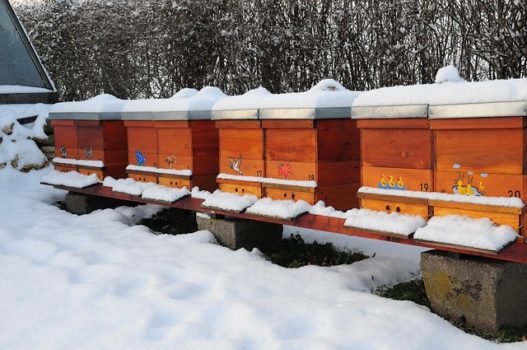
Sometimes a hives location can be a problem. If you have a hive that is in a constant wind the temperature can get extreme and just plain freeze the bees. Thinking ahead of a sheltered wintering place can really help in the winter survival of the honey bee.
Saskatraz honey bees are great for winter survival.
Saskatraz bees have cold hearty genetics as I discussed before. It’s amazing to live in time where the genetics of Russian, German, and Canadian bees can be brought together to get a strong bee variety that can winter well. Here is the whole official website of the Saskatraz honey bee project. It has all the technical information and some power point presentations.
Another really great genetic trait that the Saskatraz honey bee has is their resistance to varroa and tracheal mites. The bees selected for the Saskatraz project were specifically chosen for their traits of mite resistance. It’s interesting how they chose these colonies to work from and how meticulous they were in producing the Saskatraz variety. Again, here is the article I discuss it. Here is a link to the official Sascatraz project site.
The Saskatraz honey bee has also shown good resistance to some of the major fungal and viral issues that are facing beekeepers. These bees have shown good hygienics, meaning that they keep the hive and themselves clean. This creates less opportunity for fungus and viruses to spread or even get started.
A big issue that Saskatraz bees can’t overcome.
One thing that Saskatraz bees cannot overcome through winter is poor beekeeping practices. This is where a beekeeper might have limited knowledge on what to do to prepare a hive for winter. Sometimes a beekeeper is overwhelmed and just can’t get everything in order before winter arrives. Sometimes a beekeeper is just plain negligent or lazy. This is where a lot of problems can arise and create problems that can spread to other apiaries.
A good practice is to have plenty of full frames of honey for the bees to survive on. How much honey your hive needs is dependent on the climate you are keeping your bees in. The longer and colder your winters are, the more honey your bees will need. I live in norther Utah where it gets cold with a good amount of snow. I generally try to have 7-9 full frames of honey available for the bees in their hive for winter.
It’s also good practice to check on the bee bread. The bees will need sufficient protein to survive the winter as well. You may need to add a pollen patty to aid your hive to get the protein content up. Generally, you add pollen patties in the fall or spring. You don’t want to open up the hive in the winter if at all possible.
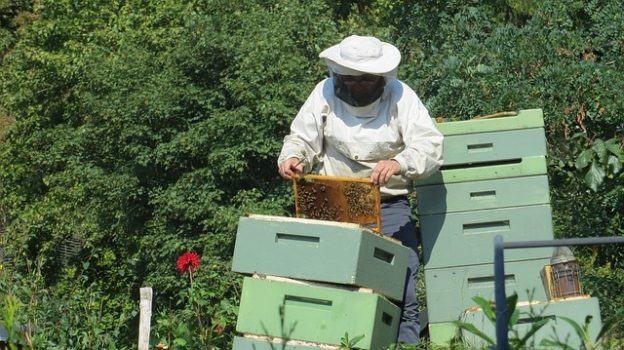
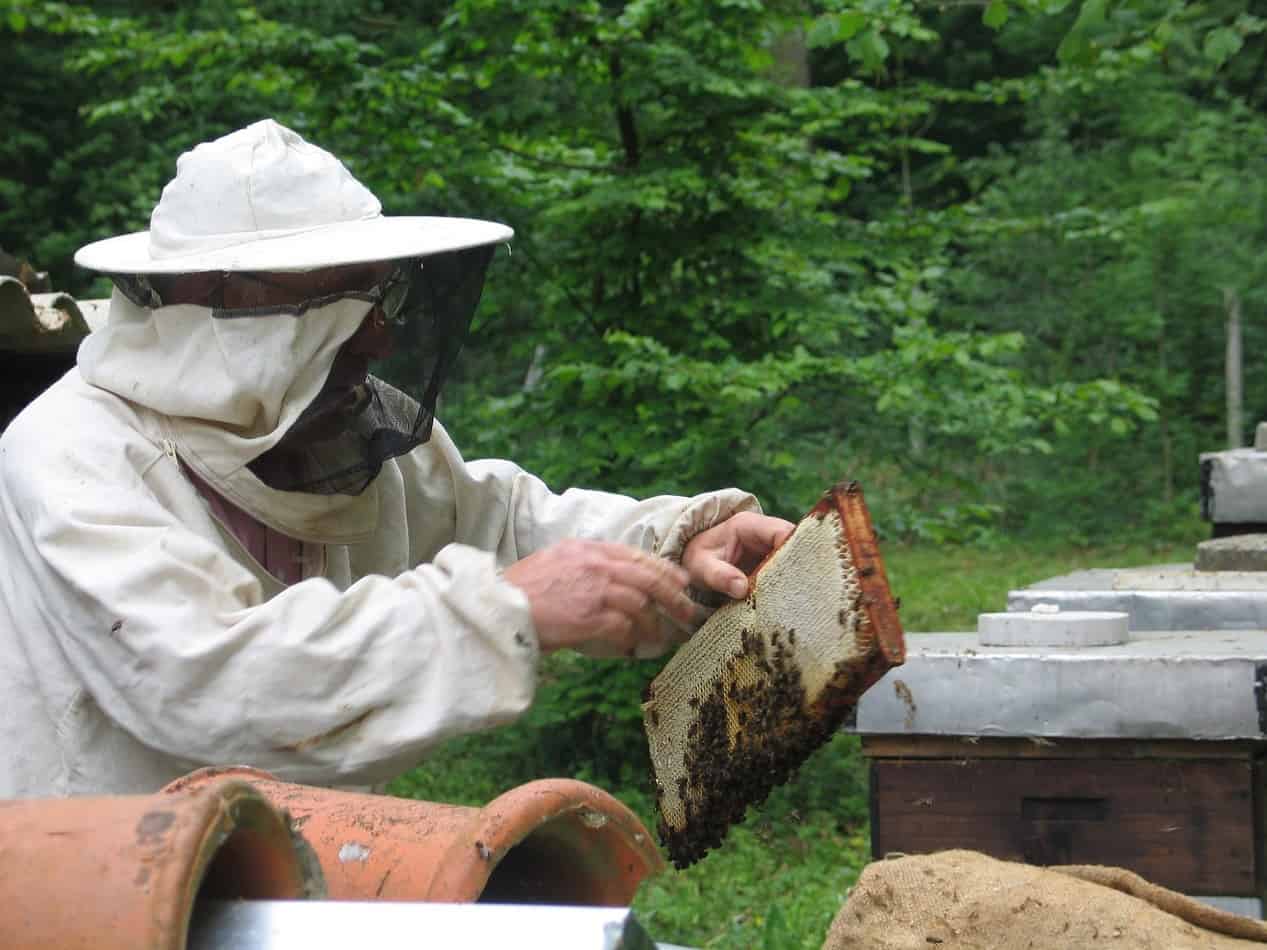
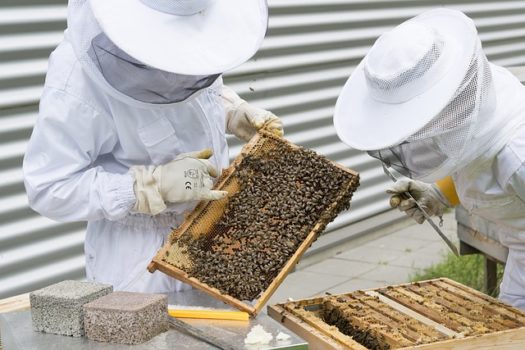
Beekeeper inspecting hives.
Please gain as much knowledge as you can when beekeeping. The more you learn the better and easier you can take care of honey bees. Also, don’t bite off more than you can handle. Many people have big ideas about how many hives and bees they can take care of. Really assess your resources and the time you have available when keeping honey bees.
Saskatraz honey bee wintering summary.
Saskatraz honey bees really are great at wintering over. They have been bred from good wintering stock from colder climates. They have great traits for winter survival, mite resistance, and fungal and viral resistance. They are over all a great honey bee to consider if you have cold winters.
Please remember that Saskatraz honey bees can’t overcome poor beekeeping practices. Poor beekeeping cannot be overcome by any honey bee no matter how great the genetics are. Take care of them well, and the Saskatraz honey bee will winter well.
What Honey Bee Should I buy, Saskatraz, Carniolan, Italian, or Other Breeds?
When I began beekeeping, I was “buzzing” with excitement, and did a lot of research regarding various bee breeds and their known characteristics. When it came time to start my own hive, I debated about the kind of honey bee I should invest in. There are many bee breeds available for novice apiarists, including great standard varieties, as well as newer varieties. I have tried both standard and new breeds, including Italian, Carniolan, Russian, and Saskatraz honey bees. This article describes my subjective experiences with each of these breeds, my opinion as to whether each breed is good for beginning apiarists, and shares some management techniques that have worked for me with each breed.
Help in deciding what kind of bee to buy.
The most popular bee in the United states is the Italian honey bee. In second place for popularity are Carniolan bees. Both breeds are great for beginners or hobbyists, as they both are known to be very gentle and both produce well within the first year or two. They are also the most recommended and readily available bees to purchase. I have raised both Carniolan and Italian varieties for a number of years and have had great success with them.
I am currently raising Russian bees and Saskatraz bees. These both are becoming my favorite bee breeds for a variety of reasons that I will discuss a little later in the article.
There are many things to consider when choosing what kind of bee to begin your adventure. I will share my research and personal experiences with different honey bee breeds, and depending on your location, climate, and what you value in a breed, hopefully I can assist you in your choice of what bees to buy.
What kinds of honey bees are there?
The main varieties or races of bees available are Italian, Carniolan, and Russian. Some other varieties available are Minnesota Hybrid, Buckfast, as well as a few commercial hybrid varieties. A new variety that has become available more recently is the Saskatraz honey bee.
There are different characteristics and strengths to each race of honey bee. As mentioned above, I will share what I have experienced with the races I have raised. Additionally, I have also researched and visited with apiarists about races that I have not raised and will let you know what I have learned.
My experiences with Carniolan honey bees.
Carniolan honey bees were one of the first bees that I raised. They came from a local supplier. He taught a beginning beekeeping class and offered a discount on bee packages to those who enrolled in his class. He gets his bees from Olvarez Honey Bees Inc.The Olvarez Honey Bee company has a good reputation and is a major supplier for honey bees in the United States. I highly recommend getting your bees from a reputable well-known source, such as Olvarez, especially if it is your first-time raising honey bees.
The Carniolan bees were really healthy and active when I got them. In appearance, they were the classic yellow/orange with darker brown/black stripes — really pretty bees. I installed them into the hive quite easily, noting no aggressive behavior from the bees at all. During that first season, I checked on them often because I was pretty excited to see the progress of my new bees. Again, as I checked on them, I noted that they were not aggressive at all. They grew the comb well, the queen laid plenty of eggs in a good tight pattern, and the brood did exceptionally well.
When it came time to harvest the honey, the Carniolan bees were a little aggressive as I took the honey from the super. I can’t blame them, as I was taking all of their hard work. It took a couple of days after I pulled the frames from their hive for them to settle down.
The Carniolans were wonderful producers. They built up all of the comb for 3 large supers, built up the colony, and were able to produce enough honey for me to take 50 pounds of honey with plenty for them to use for the winter. I was told that generally you don’t get any honey the first year because the bees are using all the resources just to build the hive and the colony itself. I was amazed and overjoyed with my Carniolan bees.
The next year my neighbors started to get honey bees and establish hives all around the neighborhood. The hives were close enough to mine that some intermingling happened. I noticed that my Carniolan bees were not doing as well as the year before. I read up and there had been an increase of varroa mites in the area. I found out that my nifty hive was plagued with varroa mites.
I then put into practice a twice a year treatment for varroa mites. I used a miticide recommended by the beekeeper I took my beekeeping class from. This seemed to work, but really put some stress on the bees. The next year the treatment stressed my hives even more and weakened my Carniolan bees. Through that winter my Carniolan bee colonies died with plenty of food left in the hive.
I started four more Carniolan hives since then with similar results. They start well, then get weaker and finally die or swarm. One colony of Carniolan bees even swarmed and vacated the hive in October. It just didn’t make much sense for the hove to leave in the fall right before winter.
So, my conclusion is that beginning beekeepers do great with Carniolan honey bees. Carniolan honey bees are readily available from good sources. These bees work hard and produce well. They however can die, or collapse with varroa mite and tracheal mite infestations. If you have a location without any other beekeepers around Carniolan honey bees are a gr犀利士eat race to use.
Traits of Carniolan honey bees that I have experienced:
They are a gentle honey bee
Good honey producer
Good pollinator
Successfully used and enjoyed by honey beekeepers for years
Readily available from reputable producers
The most popular bee in the United States
Susceptible to mite infestation
Not very hygienic, resulting in problems with disease and parasites
Does not winter well in colder climates
My experience with Italian honey bees
My experience with Italian honey bees is very similar to my experience with Carniolan honey bees. I got Italian honey bees at the same time and from the same source as I got my Carniolan honey bees. I got them from a good local supplier.
The Italian honey bees I got were a little lighter in color to Carniolan honey bees. They were easily installed into the hive. The Italian honey bees were a little more aggressive than the Carniolan bees. The Italian honey bees would try to fend me off when I checked the hive throughout the summer. Not overly aggressive, but noticeably more aggressive than the Carniolan bees. I could check the Carniolan bees without a bee veil, but I would pay the price with stings if I checked the Italian bees without my bee veil.
The Italians were really great producers. They built up the comb, brood, honey, and bee bread really well. They provided enough honey for them to winter over and I harvested 55 pounds of honey from their hive the first year.
Italian honey bees are on par with, or maybe hedge a little above the Carniolan bees. The Italian honey bees are a little more aggressive in my experience, but not overly aggressive. The guard bees of the hive did go after my father a few times as he walked by the hives. He knew to walk away quickly when those guard bees started to bump him.
I also experienced the same steady decline in the health of my Italian bees over the years. The decline coincided with a number of my neighbors establishing several more bee hives. The varroa mite infestation increased and the colonies got weaker. I found my Italian bees dead with plenty of food left in the hive throughout the winter. I never had them completely leave the hive like the Carniolan bees had. I did have the same result in mortality as the Carniolan bees even after varroa mite treatment.
It is interesting to note that all of my neighbors began to have sick and declining bee colonies at this time as well. All my neighbors who tried beekeeping have given up on the idea after their colonies either died or swarmed.
As a beginning beekeeper, Italian bees are an excellent choice to start with. Healthy bee packages are easily and readily available. Italian honey bees have been propagated and used for years and years in the United States. Italian bees are the most popular honey bee breed and often used in the same apiaries as Carniolan honey bees. They are great producers and are relatively gentle. Italian bees are however, susceptible to the mite issues that are becoming a large problem with beekeepers worldwide.
The traits of Italian honey bees that I have experienced:
Gentle bees
Good honey producer
Good pollinator
Successfully used and enjoyed by beekeepers for years
Readily available from reputable producers
One of the most popular honey bees in the United States
Somewhat prone to swarm
They are susceptible to mite infestation, virus problems and fungal issues
Challenged to winter well in colder climate
My experience with Russian honey bees.
I have kept Russian honey bees for the last 3 years. I purchased them from my same local supplier of Olvarez Honey Bees. The Russian honey bees were a little darker in color with less pronounced yellow/orange stripes. The stripes were lighter grey/brown in color.
The Russian honey bees were installed in the same way that I have always installed bee packages. The Russian bees seemed a little more aggressive at this point than the Italian and Carniolan bees.
The Russian bees established a hive quickly and did well. My inspections only needed to be brief ones. I could immediately see that the Russian hives were very vigorous, healthy, with good brood. I was surprised to see that the Russian bees needed a super added to the hive sooner than I had expected.
The Russians produced well and then the test of surviving the winter was at hand. The first winter was rather mild. The Russian hives did well through that winter and really produced the next summer season. They have made it through another winter and summer season and have done well without swarming and succumbing to a varroa or tracheal mite issue. I have not treated them with any miticides either.
I have been keeping the Russian breed of honey bee. I wrote a full article on Russian bees here. If you are interested in the benefits of Russian bees you will find great information on them here.
One factor to consider is that all of my neighbor beekeepers have given up on their hives. All of the hives local to me are dead or have swarmed and vacated the hives. I am the only beekeeper in my general area now. Perhaps that has something to do with my stronger hive and lack of varroa mite problem. The Russian bees are doing very well. They are a little more aggressive than Italian or Carniolan bees, but I am willing to deal with that for how well they are working.
Traits of Russian Honey Bees that I have experienced:
Mildly aggressive
Hearty and vigorous
Prolific makers of propolis
Becoming more available
Costs more than Italian and Carniolan bees
Winter well
Prone to swarming
Resistant to varroa mites
My experience with Saskatraz honey bees
I have only have had Saskatraz bees for one summer season and half way through one winter at the time of writing this article. I will update it when I have more to report.
I can update on the Sakatraz bees after a winter and spring. The Sakatraz bees are doing amazingly well! They came through the winter with flying colors. They were so healthy that I was able to split the hive and now both hives are really doing well! I will keep updating, but as of the end of May, both hives have filled a medium super and are ready for additional supers. I have high hopes for these bees.
I installed the Saskatraz bees just like the other bee packages that I have had in the past. The Saskatraz bees look very similar to the Russian bees. Darker in color over all without much orange/yellow, but lighter grey/brown stripes. The temperament of the Saskatraz bees are very similar to the Russian bees as well. They are a little more aggressive than Italian or Carniolan bees. They also produce quite a bit more propolis than the Italian and Carniolan bees.
The Saskatraz bees did very well through the summer and produced plenty of honey for me to harvest 25 pounds of honey from the first season. They were a bit aggressive when I harvested the frames from their hive, but not unbearable.
I have not opened the hive this winter. The season has been too cold and snowy to risk it. I have however heard the bees, and all seems to be good so far. I will update this information as time goes on.
The update is that the Sakatraz bee colonies are thriving. I have never had bees this healthy after a long cold winter. I am absolutely impressed with this bee breed. As I stated earlier in the section. Sakatraz bees do great through the winter. I wrote an article on the wintering capabilities of the Sakarraz bee here.
Saskatraz bees are just fairly recently available. They are the result of a fascinating effort to get a honey bee that can resist varroa mites, tracheal mites, virus and fungal issues. These problems are thought to be contributory to colony collapse disorder. I wrote an extensive article here about the Saskatraz bee breed and how they were developed.
Traits of Saskatraz bees that I have experienced:
Mildly aggressive
Hearty and vigorous
Prolific makers of propolis
Becoming more available
Costs more than Italian and Carniolan bees
Winter well
Prone to swarming
Resistant to varroa and tracheal mites
Not as readily available
Costs more than Italian and Carniolan bees
My research about Buckfast honey bees
Buckfast bees have not been readily available in my area. I have never raised them but have researched them to see if they would be something to try if they become available to me in the future.
Buckfast honey bees are a bee developed in England. A monk at Buckfast Abbey developed them in the early 1900’s. There was a tracheal mite infestation throughout England and many of the honey bee colonies died. The monk, named Brother Adam, took some colonies that survived and led a breeding program to raise bees that were resistant to these tracheal mites. They eventually became commercially available and shipped to Canada and then to the United States.
By all accounts that I have read, Buckfast bees are very good honey producers. They winter well and have great tolerance of tracheal mites. Apparently the only major downfall is when the next generation of queen takes over. When the second-generation queen lays eggs those new bees become more aggressive. It is a common practice of Buckfast bees to re-queen the hive every other year to prevent the colony from becoming too aggressive.
My research about Minnesota honey bees.
Minnesota honey bees are a strain from the Italian honey bee. They have been selectively bred to be resistant to American foul brood disease, and chalk brood disease. The availability of this strain of honey bee has been limited in the past.
The Minnesota hybrid seems to be very similar to the regular Italian honey bee. The exception being with the resistance to American foul brood and Chalk brood. Minnesota hybrid honey bees have also been reported to show some resistance to varroa mites.
My research about commercial hybrid and backyard home reared honey bees.
Sometimes honey bees are available from commercial growers or people trying to produce their honey bee on their own. Generally, the bees that they have available are a large mix of the bee strains that they are using in their own apiaries. The result is nothing near a straight strain of honey bee. This can be somewhat beneficial to the variety of genetics that the bees may have. The downfall is that they can be somewhat unpredictable.
Another positive is that these bees lower in cost. Some of these bees are free for the taking if you catch a swarm. You might get a colony that is a great producer of honey, and you might get a colony that is very susceptible to mite infestation or virus and fungal issues. You just don’t know the characteristics, so it’s difficult to know how to best raise them without problems.
Summary
The breeds that I would recommend to new beekeepers is somewhat dependent on where they are keeping their hives. If there is not much competition and not much chance for neighboring hives to introduce a mite infestation, I would recommend Carniolan or Italian honey bees. They are tried and true and really are great in my experience.
If you are starting your new apiary with some neighbors keeping bees as well, I would lean towards Russian and Saskatraz honey bees. These breeds are a little more aggressive and may require some swarm preventative tactics. They are however more resistant to mite infestation and can winter well if you live in a colder climate.
I would encourage you to get your bees from a good reputable source. This will get you a good quality bee colony to start with.
More information on honey bees.
We have a lot of information on bees and beekeeping on our website. Please feel free to take advantage of all the experience and research that we have. It is practical research and hands on real experience.
A few things that we have found:
Bee propolis is one of the best antibiotics for your beehive, read about it here.
Bee pollen and Bee Bread are different things, I wrote about the differences and the way bees use both in an article here.
Beekeeping is fascinating. Please look at the articles that we have written under the beekeeping link at the top of the page. You will find some great information.
Why is my Chicken Coughing? Common Chicken Illnesses and Treatment
Anyone who has
raised or bred chickens has no doubt encountered your feathered pals
exhibiting that horrible hack or sneezing accompanied by gooey, and
drippy crust that can invade their entire respiratory system. These
are just a few of the symptoms your chicken may experience when
infected with a respiratory illness. The most common respiratory
illnesses can be combated right at home with home remedies and over
the counter products, but some, depending on the severity of symptoms
will require you to take further action, including seeking veterinary
assistance.
Though respiratory
illnesses are perhaps the most common ailment your backyard brood my
encounter, here, we will talk about additional symptoms that
accompany common respiratory illnesses, as well as several other
illnesses that commonly affect backyard foul, including:
Infectious
coryza
Chronic Respiratory Disease: (Mycoplasma Gallisepticum or Infectious
Sinusitis)
Newcastle
disease
Aspergillosis
Infectious
bronchitis
Fowl pox
Avian
influenza
Bumble foot
Thrush
Mites
Marek’s
Disease
Lymphoid
Leucosis
Botulism
1. Infectious
Coryza
Infectious Coryza,
or Coryza (the medical term for the common cold) is a fairly common
respiratory disease in chickens also known as “roup”, catarrh, or
IC. In the US, it is most common in flocks found in California and
the southeast, although there have been outbreaks in the Northeastern
United States as well. Unlike some other respiratory illnesses that
can ravage your flock, Infectious Coryza is more easily treated, and
unlikley to leave lasting symptoms in stronger, adult birds. The
mortality rate for chickens infected with Infectious Coryza is
roughly 20% in most flocks. Though named for the common cold, Coryza
is much more serious in birds than a cold is in humans and is most
often accompanied by a catarrhal infection of the upper airways and
affecting the sinuses.
Chickens become
carriers of Infectious Coryza through exposure to Avibacterium
(haemophilus) parallinarum bacteria which belongs to the Pasturella
family. The infection is transmitted by direct contact, airborn
droplets, and contamination of drinking water.
Signs and
Symptoms of Infectious Coryza:
If your chickens are exhibiting any or all of the following symptoms,
they may be infected with Coryza.
Facial
swelling, including wattles eyes,
and cheeks (may cause eyes
to swell shut)
Discoloration or paleness of the comb
Discharge from the nose and eyes
Difficulty breathing
Decreased appetite
Not laying eggs
Diarrhea
Treatment of
Infectious Coryza: Like most
bacterial infections, Infectious Coryza can be treated by
antibiotics. Now this is where things can get tricky. Because the
incubation period of Infectious Coryza is 2-3 days, your entire flock
may become contaminated in less than a week. It is important that
your bird, or flock is treated with the proper antibiotic, prescribed
by a veterinarian. Treatment with the wrong antibiotic may cause
more harm than good, including ulcers, and future antibiotic
resistance. Typically, a veterinarian will run
a PCR test, or a catalese test to confirm (and to rule out other
serious respiratory ilnesses), and if it is Infectious Coryza,
prescribe erythromiacin,
streptomycin, or a form of sulfonamides according
to availability.
Home
Remedies: It is suggested by some backyard poultry folk that (in the
case where veterinary
help is not available), other naturopathic remedies may help your
chickens recover. Specifically, these folks suggest grapeseed extract
and colloidal silver.
Keep in mind, that even if your birds overcome the illness, they will
remain carriers of Infectious Coryza for the rest of their lives, and
may have both recurrences and relapses, and infect other chickens you
add to your flock.
2. Chronic
Respiratory Disease: (Mycoplasma Gallisepticum or Infectious
Sinusitis)
Mycoplasma Galliseptieum (MG) is a bacteria-like organisim that
causes respiratory diseases in chickens and is also known as Chronic
Respiratory Disease, or CRD. There are several types of
Mycoplasmosis, which are, by definition any disease caused by
mycoplasma bacteria. (Mycoplasma is about the same size as a virus,
but unlike a virus, can multiply outside of a living cell).
Many people confuse CRD with Coryza, as the symptoms are quite
similar. Diseases caused by mycoplasmosis can be difficult to
properly identify without lab testing, as they often occur in
combination with bacteria and other viruses. The disease can also
infect turkeys, pheasants, chukar partridges, peafowl, pigeons,
pigeons, quail, ducks, geese, and other birds.
Symptoms
of Chronic Respiratory Disease:
Symptoms of CRD include:
difficulty breathing
coughing
sneezing
rales
nasal discharge
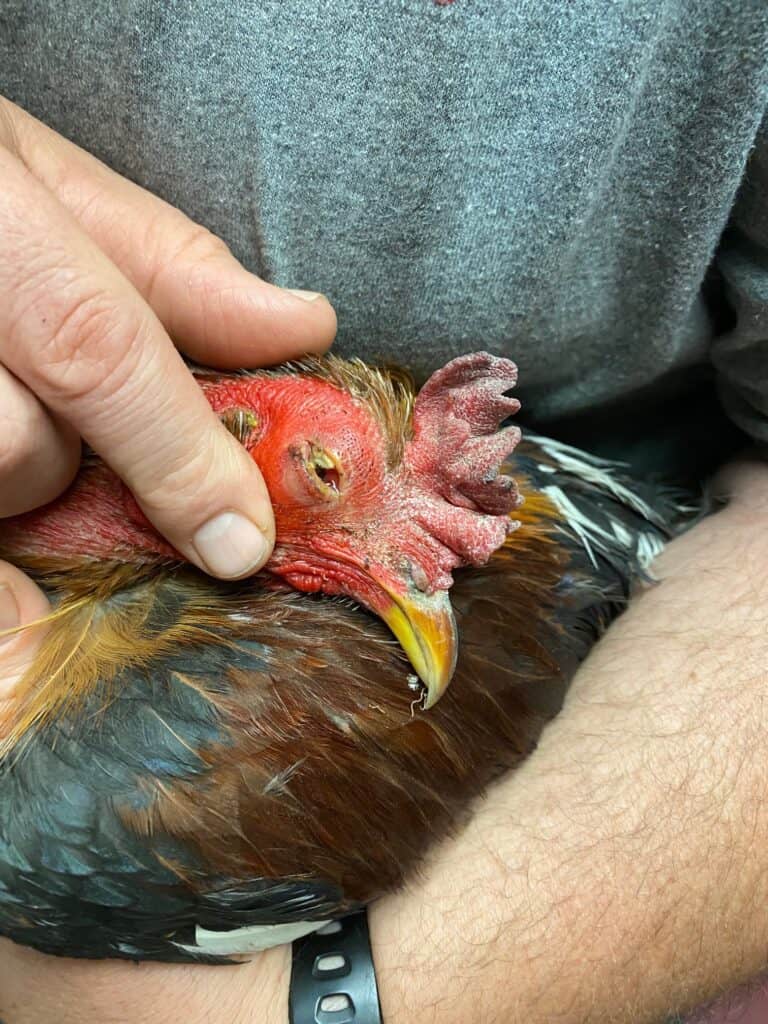
swelling of the infraorbital sinuses
discharge
from the eyes (conjunctivitis)
decreased
growth rate
decreased
egg production
Rooster with serious eye infection
The
mortality rate for chickens with CRD is quite low, however it can
complicate matters if the bird is infected with another respiratory
condition, such as bronchitis. It is also important to note that
infected chickens can transmit the disease to other chickens through
the air, feed, water or environmental contamination,
even after they become asymptomatic or recover (carriers), or to
their offspring through eggs or breeding. Birds
may remain asympt壯陽藥omatic for months until stressed, causing the
infection to manifest.
Treatment for
Chronic Respiratory Disease:
Most strains of CRD can be
treated with a number of broad spectrum antibiotics including
tylosin, tetracyclines, and others, but not to penecillin. We have
had outbreaks of CRD in our own flock. Instead of going to the
veteranarian
each time, we have found that isolation from
the flock, as well as a
topical
application of a tetracycline (Terramycin) found at most feed stores
to the sinuses and eyes will clear up an infection within a week. We
used to be able to buy Terramycin over the counter in larger doses,
that could be administered to the entire flock via water, but
regulations have halted the administration of such drugs (in
large quantities) without a
prescription from a veterinarian.
3. Newcastle
Disease
Newcastle
disease is a viral disease that effects the respiratory, nervous, and
digestive system of birds and poultry. Much less common than
Infectious Coryza or Mycoplasmosis, Newcastle disease is extremely
virulent, and often onset is
so rapid that infected birds can die without showing clinical signs.
Mortality rates of birds infected with Newcastle disease vary, but
can be as high as 100% in unvaccinated flocks.
(In
1898,
a strain
of Newcastle disease
wiped out all the domestic fowl in northwest Scotland).
The
disease has various strains for which clinical symptoms vary.
Clinical
Signs of Newcastle Disease:
Birds infected with Newcastle disease will show different
signs depending
on whether the virus they have caught had a prediliction for
respiratory, digestive, or nervous systems. Typical respiratory and
digestive symptoms involve
coughing or sneezing, (rales)
or gasping for
air, nasal discharge,
greenish watery diarrhea,
and swelling around the
eyes and neck. Nervous
symptoms involve, tremors,
slugishness, drooping or
paralyzed wigs, circling,
twisting of the head and neck, stiffness, and
clonic spasms.
Treatment
and Prevention: Chickens may
be vaccinated against Newcastle disease
in a variety of ways, most
commonly, through mass application in drinking water or by spray.
Many countries and
provinces have compulsory vaccination requirements for Newcastle
disease in commercial poultry.
4. Aspergillosis
Aspergillosis (also known as brooder pneumonia, mycotic pneumonia, or
pulmonary aspergillosis) is a fungal infection that is brought about
by the spores of Aspergillus fungus commonly found in the environment
such as soil, grains, and decaying vegetables.
The symptoms of an Aspergillosis infection in chickens includes
gasping for breath (in younger birds), and in some cases (typically
in older, more mature birds) may bring eye lesions, as well excessive
thirst, weakness, and lack of appetite. Though the affection rate for
Aspergillosis is quite common, the mortality rate is quite low
generally, (about 10%) but is often higher in younger birds or
chicks. It is transmitted by inhalation in areas with a high spore
count.
Aspergillosis infections can easily be avoided by keeping your
chickens’ environment dry and clean, and properly ventilated,
(especially the brooding pens for young chicks), and keeping the
environment as stress free as possible. It is also important to clean
and disinfect feeders and water sources regularly, and avoid any
moldy litter, feed, or dusty conditions when possible.
5. Infectious
Bronchitis
Infectious bronchitis is the most contagious viral respiratory
disease in chickens. It is caused by a coronavirus, and manifests
through symptoms of coughing, sneezing, and rattling sounds in the
throat. Young chicks are most susceptible, and can be severely
affected, although chickens of all ages and breeds are equal
candidates for infection. Mortality rates in young birds can reach as
high as 30%. Lower mortality rates (10%) occur in more mature birds.
Though Infectious Bronchitis typically affects the upper respiratory
tract, it can also affect the female reproductive tract, and some
strains can affect the kidneys, leading to acute nephritis. The virus
is spread through airborne transmission, feces, or contaminated
material or equipment, and exists in various strains throughout the
world. In adult birds, infection can lead to a heavy drop of egg
production, and misshapen thin shelled eggs of poor quality.
Prevention and
Treatment of Infectious Bronchitis: To
prevent incidence of Infectious Bronchitis, it is important to
maintain an environment that has good ventilation and optimal
temperatures for your fowl. Good ventilation will reduce the
concentration of airborne pathogens, and remove excess moisture and
toxins from the
air.
There are a number of vaccines that can be used to immunize your
flock against various strains of Infectious Bronchitis, and chicks
can also gain immunity from immunized mothers. Vaccines, (both live
and inactive) are typically applied through drinking water or as a
spray.
It is important to note that the disease can be transmitted over very
long distances by airborne transmission, so vaccination is often a
good choice for breeders situated close to other poultry farms or
operations.
6. Fowl Pox (dry
and wet)
Fowl pox is a rather common virus in backyard chickens that have not
been vaccinated. It can affect most types of poultry, including
chickens, turkeys, ducks, and pheasants. It is typically spread
through mosquitos, who ingest the virus when they feed on infected
birds. The virus then spreads when the mosquito feeds an a healthy
bird. The virus is also spread through contact with the abrasions
that form on the skin of infected birds. Additionally, as scabs from
pox lesions shed from infected birds, other birds may ingest the
virus and become infected.
Signs and symptoms of Fowl Pox include cutaneous
infections in the form of lesions. Dry Fowl Pox will result in
raised, wart-like sores, or lesions on unfeathered areas such as the
comb, head, vent, or legs, and last for 1-2 weeks. Infected birds
will display ruffled feathers, and lethargy, and may reduce egg
production. Wet Fowl Pox involves canker-like lesions internally,
such as in the mouth, pharynx, larynx, and trachea. These lesions may
lead to death if the trachea is completely blocked by lesions.
There is no effective treatment for foul pox, though where fowl pox
is prevalent, vaccination can prevent its introduction to your flock,
(typically given to chicks between 12-16 weeks of age) and
maintaining an environment where mosquito occurrence is controlled.
7. Avian
Influenza (Also Known as Bird Flu HPAI H5)
Avian Influenza, also known as bird flu is a viral disease that
affects both wild birds, and domestic birds, including backyard
chickens. There are two forms of the virus, known as low
pathogenicity, and high pathogenicity. The more common of the two is
low pathogenicity avian influenza and is rather harmless, causing
poultry to display typical flu-like or cold-like symptoms. High
pathogenicity avian influenza, on the other hand, though quite rare,
is extremely contagious and mortality rates typically reach as high
as 90% in infected poultry.
Luckily, since US poultry records began, high pathogenicity avian
influenza has only been identified in the US four times: in 1924,
1983, 2004, and 2015. Each time, it was quarantined and eventually
removed.
The only way to confirm if a bird is infected with high pathogenicity
avian influenza is through laboratory testing, though symptoms
include: decrease of activity, blueness of head area, wet or watering
eyes, excessive flock huddling and ruffled feathers, decrease in egg
production, coughing, fluid buildup in the comb or wattles, legs
bleeding underneath the skin, and sudden death.
8. Bumblefoot
Bumbefoot,
or ulcerative pododermatitis is a bacterial infection or
abscess that causes
inflammation on the feet of chickens. The
infection is typically
caused by Staphylococcus, Pseudomonas, and Escherichia coli (E coli)
bacteria.
Bumblefoot
is a common infection among backyard poultry brought about when a
chicken scrapes, cuts
or injures
the bottom of one of its feet while scratching or walking on rough
surfaces, or standing on
perches with splinters or rough edges.
These small scratches are susceptible to infection or contamination
hiding in the soil or foliage, and
are typically
part of the normal microbial environmental flora.
Once
infected, the effected area of the chicken’s footpad will become
red and inflamed. If left untreated, the infected area may spread to
the joints and tendons. In severe cases, the infection
may lead to death.
Diagnosing
Bumblefoot: Chickens
are prone to lots of adventure, spending their days hopping up and
down from hay bales, fences, rocks and machinery foraging for food.
They even spend their sleeping hours perched on roosts several feet
above the ground. During
these activities your
chickens may injure themselves with a
rough or
awkward landing causing
leg strain, broken bones,
or sprains. There are several types of injury that may cause
limping. If you notice one of your flock limping, resting, or
spending excessive time standing on one foot make
sure to do a thorough inspection before jumping to the diagnosis of
bumblefoot.
To determine if it is bumblefoot, examine the chicken’s foot
closely. During the early stages of bumblefoot, the chicken will
develop a reddish inflamed area between the toes on either the top or
bottom of the foot. This redness will increase as the infection rages
on, as will the inflammation often causing a portion of the chicken’s
foot to appear swollen or engorged. Left untreated, the infection
will next turn dark brown or black, and may appear as a scab on the
top or bottom of the chicken’s foot. At this point, a chicken will
avoid using the foot as they will be experiencing a good deal of
pain.
Treatment
of Bumblefoot: Obviously the
best way to treat bumblefoot is prevention. This
can be done by providing a diet of healthy nutrients for your flock
that is low in uric acid, and allows them to maintain a healthy
weight, and by keeping their environment safe and clean. Though
you will never be able to completely disinfect your dirt, keeping a
clean and dry environment will retard the growth of excessive
bacterial organisms in the soil. Additionally, helping your chickens
maintain a healthy diet will keep your chickens from gaining
excessive
weight, which adds pressure
to the footpads.
In
spite of the best preventative measures however, your chickens may
still experience bumblefoot, and need treatment. Depending
on the stage at which you discover the infection, your treatment
options may vary.
Early
Detection: If you detect the
infection early enough, you may be able to effectively halt its
progression with a simple treatment at home with Epsom salts and
honey. First, fill a medium sized basin with warm (almost hot) water
and Epsom Salts and soak the infected foot for 5-10 minutes. Then,
carefully dry the foot and apply generous amount of honey, which
will act as a natural antibacterial agent. You may also use
Vetericyn (available at most agricultural stores), and cover with a
layer of gauze, and then wrap tape, or vet wrap. To be extra
cautious, keep the infected chicken separated from the rest of the
flock for a day or two to ensure she does not become a victim of her
curious and at time cannibalistic flock. This process should be
repeated once a day for 2-3 days, while progress is monitored.
Late
Detection: If the bumblefoot
is detected later in the infectious stage (after a hardened scab has
formed), you may choose to involve your veterinarian. If
you have a local veterinarian who treats chickens,
they
will likely conduct a wound culture to identify the most effective
antibiotic to treat the infection. Additionally, because the foot of
the chicken is such a low blood flow area, the wound will likely
require debridement, or removal of the infected tissue and wound
cleaning. This type of treatment is obviously best completed by a
veterinarian, under sterile conditions, however, many poultry owners
choose to treat bumblefoot at home with the use of a scalpal and
either hydrogen peroxide or rubbing alcohol for disinfectant.
Removing
the infection yourself:
If you opt to remove the infection yourself, it is recommended that
you get another individual to assist. Though not complicated, the
“surgery” can be daunting
to one not accustomed to
performing minor surgeries. The surgery consists of using
a scalpal or biopsy punch (we
highly recommend the biopsy punch) to
excise the scab and remove the underlying infected core. The core
can often become hardened and attaches to the scab, making it a
little easier to remove. After removing the scab, drain the pus
from the wound, and flush with betadine anticeptic solution or
peroxide. There are numerous homemade youtube videos and articles
about bumblefoot surgery you can look up if you attempt this route.
Again, remember that once
the wound has been debrided, and the infection removed, the
chicken will need to be
kept clean, by wrapping it in gauze or sterile fabric.
Additionally, it will be
necessary to keep the chicken you have treated separate from the
rest of the flock for a few days to avoid picking. It will be much
easier to maintain that the wound area stays clean and dry if you
keep the chicken in a separate
box or pen (such as a brooding pen), until she has healed.
9. Thrush (Also
Known as Candidiasis, and Moniliasis)
Thrush in poultry is caused by a fungal yeast that affects the
gastrointestinal or alimentary tract. It is contracted by chickens
and other birds from eating moldy feed or contaminated water, or
after being treated with antibiotics. It’s symptoms typically
include a runny nose, and yellowish or white cheese-looking substance
in the croup, throat, roof of mouth under the tongue and eyes,
causing breathing problems. It also causes crusting of the vent area,
decreased appetite, droopy feathers, and lethargy.
Treatment for Thrush: If caught early enough, most cases of
thrush can be treated effectively with over the counter antifungal
creams or ointments. At our home, we have had success with Vet Rx and
Nystatin, rubbed onto the sinuses, beak and eyes of the affected
bird. Typically, the ointment is applied twice a day, and the
symptoms will improve slowly but surely within 4-7 days. Remember
that it is important to isolate the affected bird from the rest of
the flock. (Where available, copper sulphate is also an effective
treatment).
Prior to administering the Nystatin, it will be important to remove
any crust, bloat, or mucus from the bird’s airway’s or blocking
its vision if possible. The cheesy thrush can be a bit more difficult
to remove, and may require the administration of Vet Rx first, to
loosen mucus and thrush, (then waiting a few hours). Be sure to keep
a close eye on your feathered pals as they go through this treatment,
as signs of labored breathing may reveal an airway blockage that will
need removing. Subsequently, you can try using a pair of tweezers or
even a small bulb syringe to grasp the cheese-like thrush for
removal. We typically go through this mucous removal routine twice a
day. Removal of the mucous and crust will allow the bird to breathe
more freely while the antifungal does it’s work. (Note: the
cheese-like thrush infection is often accompanied by small
maggot-like worms. Though this is disgusting, it is rather common, so
don’t let it dissuade you from treating your bird).
10. Mites
Poultry Mites are rather common external parasites that are more of a
pest than anything else to your backyard chickens. They are
introduced to the backyard scene through rodents or other animals,
and are rather common in even the cleanest of coops. Mites are more
prevalent during warm weather (Spring and Summer) although some types
can survive in cold temperatures as well. The two most common
external parasites in backyard chickens are mites and poultry lice.
(Note: Poultry lice are not the same as human head lice, and people
cannot contract lice from them).
Northern fowl mites and Red Roost Mites are two of the most common
poultry mites. Mites are tiny, eight-legged pests that can either
live on the chicken, attaching to feathers, or the skin itself, or in
the coop (most commonly in the nesting boxes). Mites can come in
numerous colors, typically red, grey or dark brown, and feed on the
blood of the chicken. Poultry Mites cause a problem for chickens as
they bite and chew the chicken’s skin to extract blood from the
host, causing discomfort, feather loss, and in some cases, anemia or
even albeit rarely, death.
Signs that your
flock may be Infested with Mites: Typical
signs that your chickens might have a mite infestation include (but
are not limited to): scabs near the vent area, eggs on the feather
shafts and feathers, and even visible detection of mites on the
chicken’s skin. Another sign may be that your chickens seem
reluctant to enter their coop at night, or stop using the nesting
boxes. If that is the case, there is a possibility that the coop may
be infested. Additionally,
during an infestation, you may notice that your flock seems
to be preening a bit more, or pecking and biting at the feathers
under their wings and around their vents a bit more than usual.
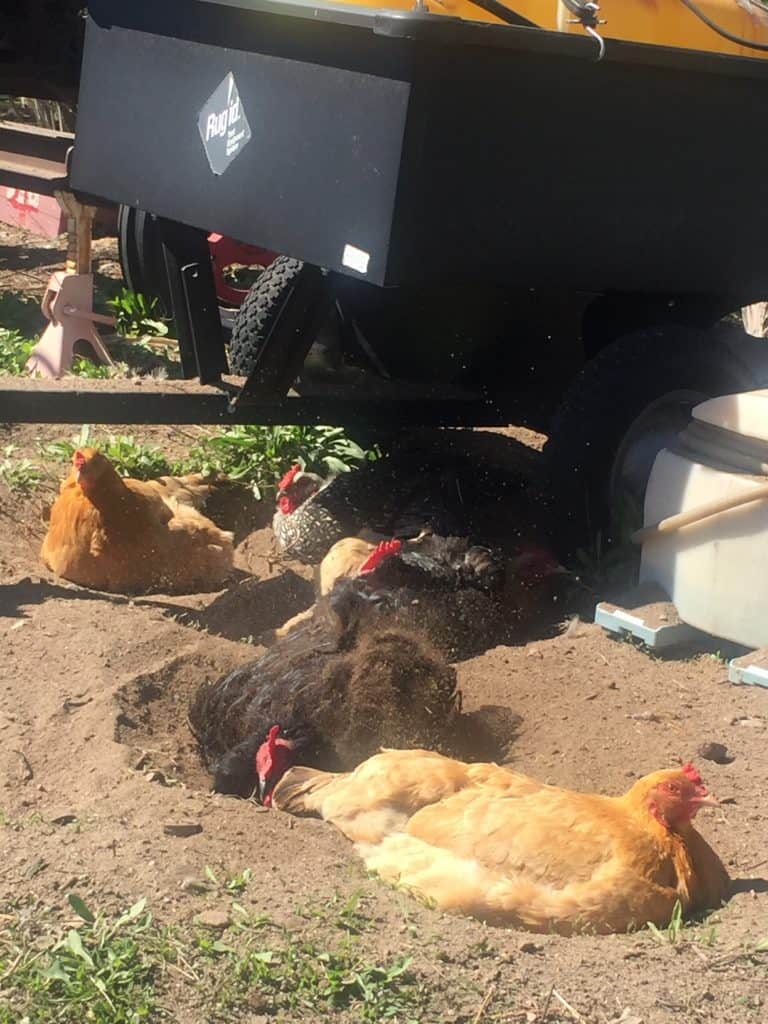
Hens enjoying summer dust bath
Treatment and
Prevention of Mites: The best
general rule to keep mites at bay is to keep a good area of dirt or
sand available for your backyard pals to take dust baths in, and
clean out the coop on a regular basis. Typically,
the dust baths that chickens take in dry patches of dirt or sand in
your yard will be sufficient to protect them from mite infestations,
however in some hot and humid areas (or during long wet spells) where
mite populations flourish, the mites may become rampant.
There are numerous home remedies recommended by backyard coop owners
that can be used to help keep your mite problem from getting out of
hand. Those include spraying your coop with a mixture of 1 TBS dawn
dish soap, 1 cup vegetable oil, and 2 cups water (mixed well), once
or twice a week; or treating your coop’s floor and nesting boxes
with food-grade diatomaceous earth (note, many backyard poulty folk
do not like to use diatomaceous earth for this purpose, as it has
been linked to be harmful for bees, and even to cause respiratory
problems for chickens), boquets of wormwood (artemesia); or spraying
your chickens directly with a mixture of garlic juice.
Other
poultry
owners use control
agents such as chemical poultry sprays, and garden and poultry dusts
with active agents such as Permathrin,
or Pyrethrum dust, or
Spinosad). Our
preferred method for treating poultry mites is poultry veterinarian
recommended Elector PSP, which can be purchased online, or at any
veterinarian supply store.
11. Marek’s
Disease
Marek’s
disease is essentially a
herpes infection in chickens (and
turkeys in close association with chickens).
Marek’s virus kills more
chickens than any other disease, and is so common that you can
probably assume
that your little flock is infected, though your chickens likely don’t
show any symptoms. It is
highly infectious, easily transmitted, and very common worldwide
among boiler breeds.
Marek’s
is a viral neoplastic
disease that can affect
chickens in a number ways. A
neoplasm is an abnormal
growth of tissue that is outside of the scope of (or uncoordinated
with) regular growing tissue. The abnormal tissue commonly form a
mass or tumor. Though
Marek’s continues to be a major threat to the poultry industry, in
most areas of the world it is kept under control through a
combination of vaccination and biosecurity practices to reduce early
exposure.
There
are six syndromes that can occur after infection with Mareck’s
disease, and their symptoms
can often overlap. These
syndromes have various manifestations, including neurological,
visceral, and cutaneous. In neurological
manifestations chickens
experience transient paralysis in legs and wings as well as eye
lesions. These symptoms are often called “floppy broiler syndrome”.
In visceral
manifestations,
affected birds experience tumors in various internal regions
including the heart, ovaries, muscles, or lungs. In
cutaneous
manifestations,
chickens develop tumors on their feather follicles.
Most
backyard breeds will never manifest active symptoms, unless exposed
to highly stressful situations such as crowding, moving, or
predators. Chickens
infected with Marek’s may exhibit various signs or symptoms,
including:
Paralysis of legs wings and neck
Vision problems
Discoloration of pupils or iris (typically grey in color)
Lack of appetite
Sudden death
Twisted neck
Weight loss
Raised skin around feather follicles
Lesions
There
is no treatment for Marek’s disease, however, as
stated above the
disease can be prevented through vaccination, and
is kept in check largely by boiler breeders through biosecurity
measures and vaccinations.
Another
method for prevention is brooding new chicks away from other adult
birds for several weeks, as the first few weeks of life are the most
critical time for infection.
12.
Leukosis
Like
Marek’s disease, Leukosis causes tumors in chickens and can have
equally devastating effects. Leukosis usually affects chickens just
reaching maturity, and involves the development of neoplasms most
likely to cause Lymphoid Leukosis or osteoptrosis (which is the
thickening of the leg bones). Also like Marek’s, Leukosis, not
only develops into tumors, but also infects
the white blood cells which lowers a
chicken’s ability to fight other infections.
Signs and symptoms of Leukosis may involve:
initial cough
diarrhea
weight loss
listlessness
thickened and bowed legs
Like Marek’s, there is no treatment for Leukosis, and affected
chickens will die if not euthanized. Unlike Marek’s, however,
Leukosis cannot be prevented through vaccination. If you believe your
flock is infected with Leukosis seek veterinary help immediately.
13.
Botulism (also known as
“Limberneck”)
Botulism
is a rare bacterial infection that occurs
worldwide and is caused by
a
bacterial toxin produced by Clostridium
botulinum.
Chickens
may become
poisoned with
botusism
toxins after
eating or pecking
at toxic organic matter such as the carcasses of dead animals or
plant
waste.
Though the botulinum bacteria commonly lives in the intestines of
chickens, it does not become toxic until it multiplies in the
carcasses of the dead plants or animals.
Once poisoned with the botulinum toxin a bird will gradually become
paralyzed from the feet up, often looking dead for hours before
actual mortality. As paralysis progresses through the body the
chicken’s wings will droop, and its neck will go limp, eventually
paralyzing the eyelids, lungs, and heart.
Though
the disease is rare, it’s mortality rate is high once infected.
Treatment
for botulism in chickens involves the speedy
administration
of an antitoxin by a veterinarian, or simply by squirting a mixture
of cool water and epsom salts into the bird’s crop. As with most
chicken illnesses however, the best manner in which to treat, is to
prevent the occurrence of the botulinum toxin through practicing good
sanitary measures.
What are Saskatraz Bees? Are They an Answer to Colony Collapse?
In the increasing battle to raise honey bees there is a new variety on stage. The Saskatraz honey bee shows some amazingly good promise to do well in the battle against varroa mites and tracheal mites which are a component of colony collapse disorder. They also area a gentle, hearty, good production variety that can winter well.
I have had a colony of Saskatraz honey bees, and they are doing great. Let’s explore these honey bees and I’ll let you know my experience with them.
Saskatraz bees are newly available
The Saskatraz honey bee is relatively new on the scene of beekeepers. They are a result of extensive breeding programs where positive desirable traits were observed and bred into the Saskatraz bee. They have become commercially available to the public only in the last few years.
Most beekeepers have been using Italian, Carniolan, and Russian bees in their apiaries. These varieties have been susceptible to varroa mite, tracheal mite, and fungal issues such as American Foul Brood. Russian bees have shown some positive traits in the battle of the varroa mite. I have another article about them here. I have had Russian bees for a few years and really have enjoyed and done well with them.
Infestation of varroa mites and tracheal mites have resulted in the declining health and death of many honey bee colonies. It is also considered to be a factor in the increase of colony collapse disorder that’s plaguing many areas of the world. Colony Collapse Disorder has resulted in the decline of pollination and loss of crops. To put this into perspective, the honey bee is indirectly responsible for one third of the world’s food supply and 90 different plant species.
So, the decline of the honey bee has very real and drastic effect on human life.
What’s with the name Saskatraz?
If you’re like me, you might find the name Saskatraz interesting. It brings up the idea of Alkatraz prison, or some kind of crazy Tasmanian devil bee or something. The name actually comes from the apiary, or bee farm, where this strain of bee was developed. The apiary is located in Saskatchewan Canada.
The location was very remote and isolated form other beekeepers, growers, and possible contaminators of the development process. It kind of sounds like an isolated prison colony of bees. I have not been able to verify that the name is after the famous prison Alcatraz, but it does come to mind. The only information that I have definitively found for the name is that it’s the name of the apiary that these bees were developed in in Saskatchewan Canada.
History of the Saskatraz Honey Bee
The Saskatraz bees were developed by Meadow Ridge Enterprises Ltd. in collaboration with the University Saskatchewan and Queen breeders from Manitoba and Saskatchewan in Canada.
The goal was to get a bee that would combine all the good and beneficial traits of these colonies of honey bees. That way the bees could combat the issues naturally without miticides, while also being a gentle good pollinator and honey producer.
Miticides have been used for quite a while with limited results. My personal experience with miticides have been mixed. When I first used miticides they worked well. My bees were healthy and seemed fine. I was taught in a beginning beekeeping class that using a miticide was common and had always been done and was good for my hives. I used a more organic miticide and thought that was a good way to keep my honey bees safe and healthy. I did notice that over the years the miticide seemed to be pretty rough on my honey bees and weakened them. The cure for the mites seemed to be worse than the mites themselves.
The Saskatraz project was trying to get a strain of bee that you wouldn’t need to use any miticides and you could combat these pests naturally. What the beekeeping world is finding out is that the mites are growing tolerant to the miticides that are being used. The common practices of using a miticide with a mite infestation was creating a stronger mite resistant to the miticide. A better solution needs to be found as colony collapse disorder is becoming more and more common.
The Saskatraz project put together a powerhouse team of Doctors, Doctorate students, and successful honey bee queen producers to breed a strain of honey bee that could battle varroa mites, tracheal mites, viral, and fungal issues; but still be gentle and a good producer. To do this they got queens and drones from specific honey bee colonies in Russia, Germany, and Canada. The beekeepers had colonies of honey bees that had demonstrated good results with resistance to varroa mites, tracheal mites, and fungal issues.
They also needed to have a good variety and diversity of genetics to work with. With more diverse genetics the bees will hopefully be stronger and more virile as they are introduced to professional beekeepers and the general public.
The goal of the Saskatraz project is to create a super bee of sorts. The queens and drones were selected from these specific areas due to characteristics that the colonies displayed. The specific qualities of being resistant to varroa mites, tracheal mites, viral, and fungal diseases were observed and bred into different honey bee colonies.
It’s taken a few years of meticulous breeding and observation to come up with the strain of honey bee they were looking for. Through the Sakatraz project scientists and beekeepers were able to track the traits they wanted in the bees from these colonies from all over the world. The result is the Saskatraz bee.
The Saskatraz bee has great characteristics. They are naturally resistant to varroa mites and tracheal mites. They aren’t perfectly immune but are much better at resisting the mites. Testing shows dramatically less, or no population of mites in a colony.
Saskatraz bees are more hygienic than other breeds of honey bees which could contribute to the lower occurrence of the mites. Testing is being done to see if it is the longer leg length attributing this aspect. Longer legs would allow the bees to reach more of themselves to clean off the mites.
Sascatraz bees are also showing good resistance to some of the fungal issues that plague beekeepers. Testing is still ongoing, but American foulbrood and chalk brood are also dramatically lower in occurrence, or non-existent in Saskatraz bee colonies.
Saskatraz honey bees are a gentile bee similar in temperament to Italian bees. They are good produces or honey and comb. The Saskraz honey bees are good producers of propolis, wax, and beebread. Generally, they have the same good characteristics of breeds commonly used by professional and hobby beekeepers.
If you would like to read more about the personality or temperament of Sakatraz bees, I wrote an in-depth article on the temperament of Sakatraz bees here.
My experience with Saskatraz bees
I have been keeping bees for a number of years now. My first few years with beekeeping were the golden years. I had both Italian and Carniolan bee colonies. They did amazingly well! I harvested 120 pounds of honey from 2 hives the first year I had them with plenty of honey left over for the bees to winter over.
Beekeeping became popular in my area and many hives showed up in the neighborhood. This concerned me, but I thought more bees meant better pollination, more honey and the world would be a better place.
Well, this explosion of beekeepers proved to be the opposite. It just became an ongoing spreading of mites. My hive soon showed a decline in health and an increase in mite infestation. I treated my hives and kept the health up for a while.
Eventually my hives experienced weakness and death. I would start a new hive with everything looking good and by harvest time in the fall the hives would be weak, and some would even swarm in the fall leaving an empty hive.
I tried Russian bees couple of years ago with good success. These seemed to have the same vigor as the bees I had the first time I started to try beekeeping with Italian and Carniolian varieties. The Russian hives produced well, but not quite as much as my Italian and Carniolian breeds.
I then was introduced to the Saskatraz bees. I had never heard about them and decided to do some research. They sounded a bit too good to be true, but really worth a try.
I got a bee package of a Saskatraz queen and 3 pounds of workers. The workers were Italian bees. I set up a hive in Late April.
The set up was done the same way I had installed bee packages in the past. I put the queen in the hive with a candy plug in her cage allowing the workers to eat the plug and free the queen. This takes some time, 24-48 hours generally, and allows the workers to bond with the queen.
I gently dumped the workers into the hive and let them work at establishing the hive and getting used to the pheromones of the queen as they freed her from her cage. This process has worked well in the past and the method many beekeepers use.
I monitored the hive closely and it progressed at the same rate that I was used to with other bee packages. The queen was accepted and laid a good tight pattern of eggs. The pattern of egg laying can give a good indication of the health of the queen. A tight pattern is a good indication of a healthy productive queen.
The brood was healthy, and the hive progressed well. I did notice that the Saskatraz bees seemed to create more propolis than I had experienced in the past with Italian and Carniolian breeds.
Propolis is amazing stuff. I have an article about bee propolis here. You can find out how bee propolis is important for the health of your hive and the battle against bacteria and viruses. These viruses and bacteria are thought to be contributors to colony collapse as well.
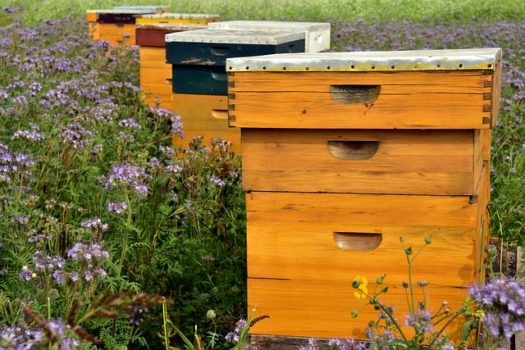
One of our Saskatraz honey bee hives on the north pasture.
The hive did very well throughout the summer. I was concerned because my area experienced drought conditions and the availability of flowering plants was a bit limited compared to a normal water year. The Saskatraz colonies did just fine and thrived.
The Saskatraz hive produced plenty of comb, brood, bee bread, and were abundant in honey. I was surprised at the success of the colony. I usually need to leave most of the first seasons honey to get the new colony to survive. My Saskatraz bees produced enough honey for themselves and filled a full sized super beyond.
Where to get Saskatraz Bees
Olvarez Honey Bees are the exclusive distributer of Saskatraz bees in the United States. They however have become a distributor to other bee suppliers nationwide. I have seen that most honey bee providers have access to Saskatraz queens and can create a bee package for purchase. I will warn you to order them early. The Saskatraz bee is becoming very popular in the beekeeping world.
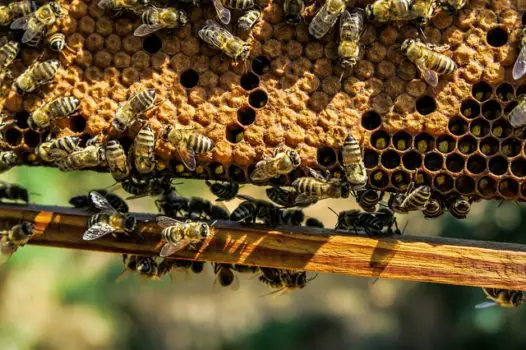
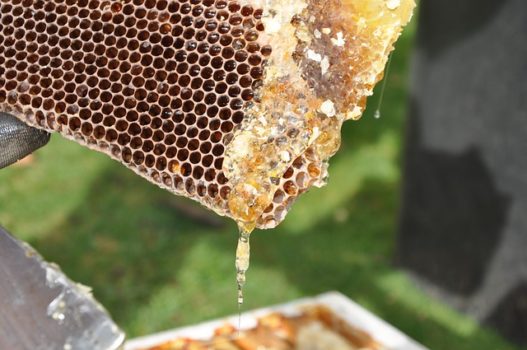
Honey from a frame.
Summary
Saskatraz bees are a bee variety that has been bred to have some really amazing and beneficial traits:
They are great honey producers.
They resist varroa and tracheal mites.
They have a resistance to fungal and viral problems that many beekeepers have experienced in their hives.
They winter well.
Saskatraz honey bees seem to be a great bee for the commercial and hobby beekeeper. In my research some beekeepers had the experience that the Saskatraz hives were prone to swarming. I have yet to experience swarming issues with my Saskatraz bees. I do however take precautions in the spring to try to discourage swarming.
Chapter Two on Saskatraz Bees
We have had Saskatraz colonies for a couple of years now. We have had some great success with them from splitting the hive and seeing amazing growth and vigor. If you’d like to read my updated article about our experience with Saskatraz bees regarding year two of working with them, click here.
The complete guide for Bromeliad plants…and their little pups too.
We received a beautiful plant for Christmas this year called a bromeliad. These tropical plants are exceptionally colorful, and are often gifted for weddings, holidays or special life events. They are relatively easy to care for and can last for years if you know what you’re doing. Let’s see how to take care of them and enjoy them for years to come.
The holiday of all holidays has passed and we are again easing into a regular routine. The house has been put back in order, but this year something is different. We had many guests come to our home, most left after a period of time, but one decided to stay. As is customary we like to call our guests by their first name and so our official new roomie answers to the name of “Bromie”.
WHO OR WHAT IS “BROMIE”
Our guest has an official name of Bromeliad and is a relative of the orchid plant and the pineapple plant and originates in the South American tropical forests. They can be found hanging on trees and limbs of cactus, but also on the forest floor. Certain species of Bromies have been cultivated to be excellent house plants.
Bromeliad plant hanging out on a tree.
These beautiful tropical plants are very fine house guests because they require little care and upkeep. Bromeliad plants are often epiphytic and cling to trees or other structures. They are not parasitic, but simply use the structures as perches from which to gather sun and moisture. Some bromeliads grow well as air plants or tillandsia plants.
WHAT DOES OUR “BROMIE” LOOK LIKE
“Brome”
This exotic plant adds COLOR to any room. It comes in several varieties and each one has a particular look, color and personality. Our visitor is called Guzmanias and has dark green leaves are in the shape of a spike with a rounded cup at the area where it joins the flower stem. Some of the leaves are 18 to 24 inches and in the center is this gorgeous spire that is almost two feet tall and the most beautiful bright red. This is where the flowers appear when the plant is ready to bloom.
Each variety of bromeliads has its own special look, some with short very colorful leaves such as the Aneoregelias variety with a small center cup for water. Another variety called the Pink Quill plant has very thin leaves, much like the daffodil, and produces a center single leaf, much like a feather hence the name. This center leaf is bright pink and the flower of this variety is a striking lavender. One of the most popular bromies is the Aechmea Fasciata. This captivating plant has variegated spikes for leaves (rather short and fat). The center produces a bright pink plume that remains colorful until the plant produces small flowers.
GROWING CONDITIONS FOR THE “BROMIES”
At first glance this beautiful house plant looks like it would require a significant amount of tender care with a high degree of maintenance, BUT NO . . . a place where there is significant diffused light and temperatures between 60 and 80 degrees. Direct sun will burn the leaves. Since bromeliads need little or no soil to grow, the plant gets its nourishment from the water it receives. Most plants have a center “cup” that holds the water that the plant uses. Some just get water from the center of the leaves where they attach to the flower stock. If there is any soil around the bottom of the plant, it should also be damp, but not wet.
When growing these spectacular plants, set their roots in shallow potting soil that is used for orchids or a bromeliad potting mix. It can also be a blend of bark and sphagnum moss. The pot should be shallow. Again, do not over water. Every week or two, empty the water that remains in the center bowl or leaves. Make sure that the pot has drainage.
If the air in your home happens to be a bit dry, the Bromie would appreciate being set upon a bed of pebbles that have water in the bottom of their tray. This would provide the humidity that would help this plant thrive. Bromeliad plant care is easy and requires no special tools or fertilizers. Feed the plants with a half strength fertilizer each month in the growing season (usually during the spring and early summer).
BROMELIAD LIFE CYCLE
This plant has a life cycle that is usually four or more years. It takes a good two years to get the plant to a mature stage. As the plant matures the color becomes more apparent in the leaves of the plant. Each type of “bromie” has its own distinct shape.
The Pink Quillplant usually only gets about 12 inches.
The Neoregelias are smaller, usually 8 to 10 inches and about 10 inches across.
The Queen’s Tearsis a rainbow-colored plant that produces upright clumps of trumpet-shaped, grayish-green leaves. Arching stems bear pink bracts and line green petals rimmed in royal blue.
Each long-lasting flower displays a long yellow stamen. As each bromeliad flowers, their presentation of the blooms is different, but this usually signals the beginning of the end.
WHAT TO DO WITH A LITTER OF “PUPS”
But not to fear. As the colorful stocks begin to fade, inspect around the plant. Bromies produce offspring called “pups”. Though bromeliad can be reproduced by seed, it is a long and arduous process to get fertile seed and it usually takes about 6 years to produce a plant.
So, take note of the little growths that will appear around the base of the plant. The plants will take nourishment from the mother and as they grow, she will fade away. There will come a time when the mother stock will be all brown. Just trim it out and start naming your new litter of pups. Some plants have been known to produce as many as seven pups.
Here is how to take care of your pups:
When the pup is about 1/3 the size of the mother plant, you can separate it from the mother by using a sharp knife or blade.
After separation put the pup in a shallow pot with a potting mix for bromeliads or orchids.
Dampen the growing medium and make sure the pup has a good draining system.
Continue with watering in the cup of the plant. The water is about ¼ of a cup.
Add diluted fertilizer to get it started.
If the pup is going to stay in the original pot, the mother can be transplanted to another pot and more pups may develop before the mother stock is completely ready for the compost pile.
Be sure and have a proper funeral and burial for your family member.
A NEW HOME FOR BROME
Your bromeliad plant will probably not need to be replanted, but maybe every four or five years. Then only maybe a pot that is one or two sizes bigger. This house plant does not grow fast. If you have several pups you have transplanted into individual pots, it will take two or three years to develop a mature plant.
Repot your plant in the warmer months, not the cooler ones while the roots are taking a bit of a siesta. Their life span will probably be four to six years, so give them a name, a place to call their own and talk to them.
They are a bit vain, so love to hear how beautiful they are. You will love to hear the oohs and aahs or your human visitors as well.
AUNTS AND UNCLES OF YOUR BROME
There are several names of the various types of bromeliads. Oueen’s Tears is a unique plant and is sometimes called the friendship plant. The Pink Quill plant always gets a second glance with its unusual foliage. Colorful indoor gardens are developed with Neoregelias and they enjoy group gatherings. The bright flower and variegated leaves of the Aechmea Fasciata is always welcomed whether it is a family gathering or an honored guest status. Perhaps most regal of all is the stately Guzmanias (my favorite) and she proves to be an appreciated part of our family. All in all, this has been a most spectacular holiday with our new family member.
DO “PUPS” AND KITTIES GET ALONG
If you have a love for living things and I assume you do if you find “bromies” interesting and have chosen to make a place in your home for them, then you probably have other living creatures with four legs that share your domicile. Like a kitty cat or puppy dog.
Kitty cats seem to have a fondness for bromeliads.
Your litter of bromeliad pups can be contained in pots to meet their size (shallow and about 1 to 2 inches bigger around than the pup). But four-legged kitties can find intrigue and adventure around any and all of your bromeliad plants. They also figure that the beautiful leaves are there for lunch. Don’t worry. These leaves are not harmful in any way – at least your cats or dogs. You may have to curb the lunch crowd if your plant is showing any signs of stress.
TO PRUNE OR NOT TO PRUNE
That is the question. The bromeliad plant does not need any pruning or training by cutting in its growth pattern. If a leaf starts to go brown, just sever it from the main plant. The center stock and flower will eventually fade and go brown. Then you will need to trim it out being careful of any pups that are attached. Some mother plants will host several pups and may need to be transplanted until all the pups are weaned and on their own. The life of a “Brome” can be from four to eight years.
The Russian Honey Bee is More resistant to Varroa Mites.
If you are a beekeeper, then you know the dreaded Varroa Mite. These lousy parasites can take down the health and can even kill a healthy honey bee colony. There are some strains of honey bees that are resistant to varroa mite. These are Russian honey bees and Saskatraz honey bees.
I have been a beekeeper of Russian honey bees for a few years now and love them. They are hearty and do well in the cold conditions where I keep my hives. I will let you know what I have found about them and how they have worked for me.
Varroa Mites
Varroa mites are terrible parasites that will propagate in a bee colony and become a nuisance, effect the health, and eventually can kill the colony. These mites will attach themselves to a honey bee and feed off the blood of the bee. While feeding off the bee they will spread viruses, disease, and harmful funguses.
In the reproduction cycle of the Varroa mite they lay eggs into a brood cell. As the bee egg hatches so does the mite egg. There are about 10 varroa mite eggs laid per one honey bee brood cell. Generally, one male varroa mite egg and the rest are female. When the bee emerges from the brooding cell so do the varroa mites. They then spread throughout the hive. This essentially creates exponential growth of the varroa mite which infests a hive.
These mites have been linked to the death of many honey bee colonies worldwide. The stress caused by these parasites has been felt by the honey bee community worldwide. Which results in death of honey bees, honey bee colonies, poor pollination, and colony collapse.
I have a more in-depth article on the varroa mite here. I discuss more of the effects, causes, and cures for the varroa mite.
As transportation got easier in Russia with the Trans-Siberian railway goods and supplies were increasingly transported to the far eastern part of Russia. Honey bees were transported to the Pacific coast of Russia where the varroa mite naturally occurred. This occurred in the mid 1800’s. It is believed that this introduction to the varroa mite at this time lead to the development of a genetic resistance to the varroa mite.
Fast forward to 1995-1996 Russian hives were tested in the Primorsky province of Russia. The Russian bees had significantly less infestation than other domestic honey bee colonies. They still had varroa mites present in the hives, just less of them compared to the domestic colonies.
USDA Russian Bee Testing
In 1999 and the year 2000, the USDA did some field trials in several states of the Russian honey bees. They did the trials in Iowa, Louisiana, and Mississippi with interesting results.
There were several colonies located in each state and inoculated with varroa mites and tested after 91 days. The predicted growth rate for domestic colonies wat about 17.5 percent. The growth rate of the Russian colonies was a lot less. The Louisiana colonies reported only 2.5 percent growth rate and the Iowa and Mississippi colonies reported no to very few varroa mites detectable.
Are Russian Bees free of Varroa Mites and the answer to the Varroa Mite problem?
From the studies it looks like Russian bees could be a possible answer to the varroa mite problem. The Russian honey bees show that they have a resistance to the varroa mite, but not an eradication of the mites. The varroa mites have a difficult time reproducing their normal way with the Russian bees. That is, they don’t do well with the traditional laying of eggs with the honey bee egg in the brood cell, attaching to the brood, and living their normal life cycle in the hive. However, this is not the only way the varroa mite will infest the hive.
Worker Bee
As the bees go out to collect nectar and pollen, they collect more than just that. Varroa mites from other honey bees can be left at collection sites. At these collection sites any bee, including Russian bees, also collect the little varroa mites that will hang on and hitch a ride back to the hive. As the nectar and pollen are gathered so are the varroa mites and can begin to infest the hive.
Varroa mites are also spread by robber bees. Honey bees are opportunistic. If they sense a weaker hive, they will become robbers of that hive. So, if another hive is weakened by a varroa mite infestation then the stronger colony will rob as much as they can. This will also include bringing the varroa mites from the weaker hive to your stronger hive.
Russian honey bee behavior
A trait that seems to help with the lower varroa mite count in a Russian honey bee colony is their behavior. They are a little bit more finicky about cleanliness. The workers seem to do a better job at cleaning themselves. They are fastidious little creatures wanting to keep things ship shape. This cleaning behavior seems to aid in keeping the varroa mite population down.
My experience with Russian honey bees.
I have been keeping some Russian honey bee hives for a few years now. I have found them to be similar in nature to Italian honey bees. Their temperament is fairly docile and seem to be good natured. I have noticed that they produce a large amount of propolis sealing up every corner or crack.
Russian Honey Bees are great honey producers.
The Russian honey bees have been good honey producers from the first season on. I pulled/harvested honey in September the first year after setting up the hive in April producing 42 pounds of honey. The next year I pulled/harvested honey in June producing 30 pounds of honey. I pulled/harvested from the same hive in September of that year producing 70 pounds of honey.
Fresh raw honey harvested from our hives including Russian hives.
I have not done any propolis harvesting or pollen harvesting with these colonies. I have observed that the colonies that I have worked with create a large amount of propolis. The pollen accumulation seems to be about the same as my other honey bee varieties.
I have not treated my hives with any mite treatments or antibiotics. I have found the mite treatments have done more harm than good to my bees. There is also a concern by many beekeepers that the treatments of the varroa mites are creating a stronger strain of mite that is resistant to the treatments anyway. I am trying to have colonies that are as natural as I can make them
The Russian honey bees have wintered well. I have had some challenges with Italian and Carniolan bees. Some years Italian and Carniolan bees have swarmed in November. Some years the Italian and Carniolan are dead with ample supplies of honey and bee bread. The Russian bees have wintered over well and been very robust in the spring when winter breaks.
Summary
Russian Honey Bees have had good resistance to varroa mites. They are not a silver bullet for the varroa mite issue but are good at keeping varroa mite populations lower than other honey bee varieties. I have had good success with Russian honey bees after 2 winters and 2 summer seasons. The bees are still healthy this winter and I am hopeful for the upcoming summer.